


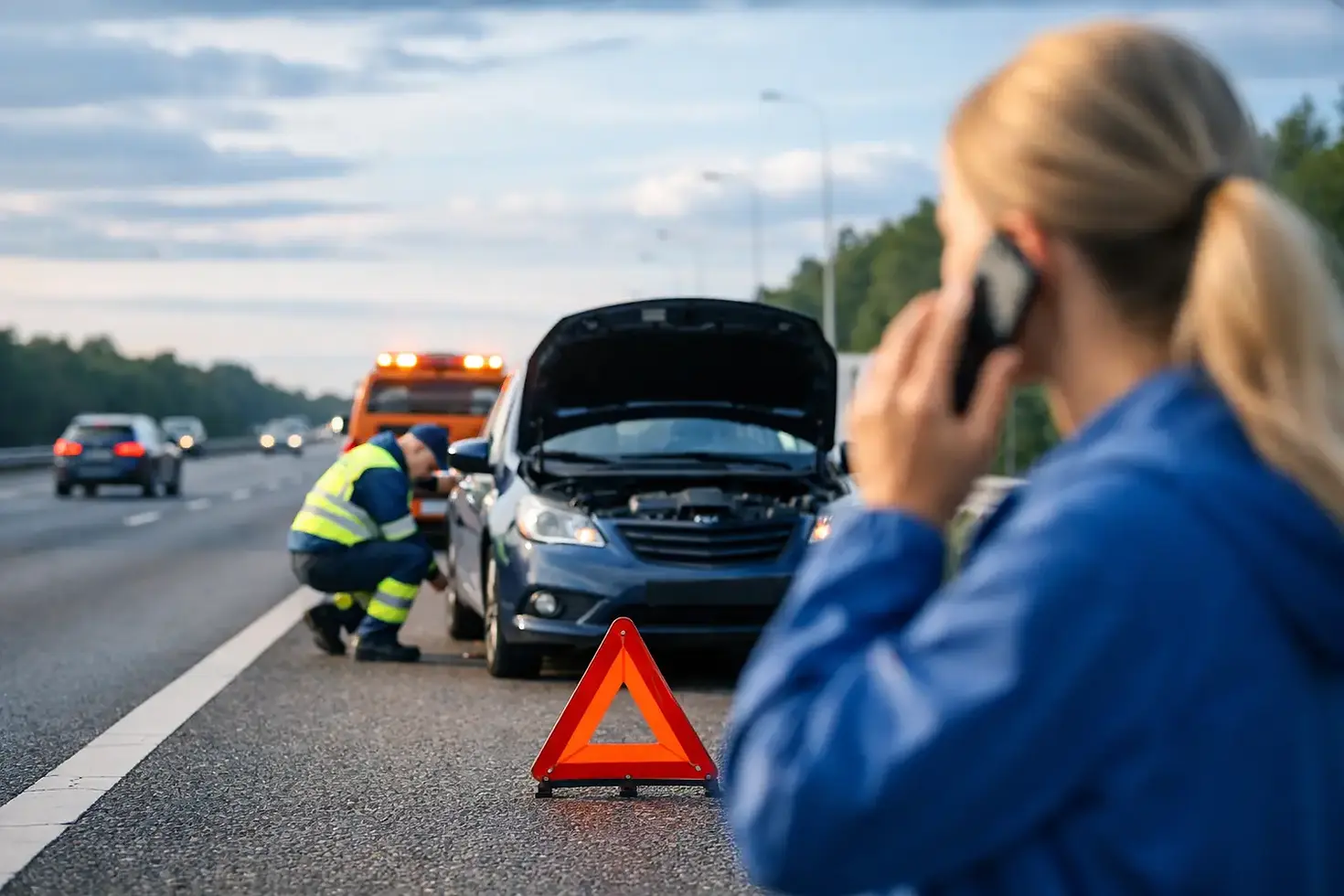
How to Handle Motorway Breakdown Safely
- contact972449
- May 19
- 6 min read
A motorway breakdown is never convenient, but the real risk comes from what happens in the first few minutes. Knowing how to handle motorway breakdown safely can protect you, your passengers and other road users while help is on the way. On a fast-moving road, staying calm and making a few clear decisions quickly matters far more than trying to fix the problem yourself.
How to handle motorway breakdown safely from the moment trouble starts
Most motorway breakdowns do not happen all at once. Often, there is a warning first - a loss of power, an unusual noise, a tyre issue, smoke, a warning light, or the feeling that something is simply not right. If you notice any of these signs, do not ignore them and hope the car will carry on. Your aim is to leave the live traffic lanes as soon as it is safe to do so.
Put your hazard lights on straight away. This alerts drivers behind you that you have a problem and may be slowing down unexpectedly. If your vehicle can still move, guide it towards the left-hand side and look for a safe place to stop. On a traditional motorway, that usually means the hard shoulder. If you can reach a service area or a proper exit safely, that is often even better, but only if the vehicle is still driving normally enough to get there without creating more danger.
Do not stop on the carriageway unless you have no choice at all. A live lane is the most dangerous place to be. Even if the car still rolls, use that momentum to get as far left as possible.
If you can reach the hard shoulder
Pull up as far left as you can, with your wheels turned left. Leave room between your vehicle and the traffic if possible. Put your hazard lights on and switch on sidelights if visibility is poor.
At that point, your priority is not inspecting the fault. It is getting people out safely. If it is safe to do so, leave the vehicle through the left-hand door and move everyone behind the barrier, well away from the road. Children should be kept close to you and pets should stay inside the vehicle unless you can control them safely outside. A frightened dog on a motorway hard shoulder can quickly turn one problem into two.
Once you are in a safer place, call for breakdown recovery or emergency assistance. If you use your mobile phone, give clear location details. That could be the motorway number, direction of travel, nearest junction, and any marker post numbers nearby. Those small blue location signs and marker posts are extremely useful, especially if you are somewhere unfamiliar.
If you break down on a smart motorway
This is where people often feel least confident, and understandably so. A smart motorway may have no continuous hard shoulder, which means your next move depends on where you are when the problem starts.
If your vehicle is still moving, try to reach an emergency area. These are designed for breakdowns and are much safer than stopping in a live lane. Use your hazard lights and, if needed, reduce speed steadily rather than sharply. Sudden braking can make a bad situation worse.
If you cannot reach an emergency area and the vehicle stops in a live lane, put your hazard lights on immediately. If it is unsafe to get out, stay in the vehicle with your seatbelt on and call 999. This is one of the key it-depends moments. On a normal hard shoulder, getting out and standing behind the barrier is usually safest. In a live motorway lane, stepping out into passing traffic may be far more dangerous than staying put. The advice changes because the risk changes.
If you do make it into an emergency area, use the emergency phone there if available, or call your recovery provider. Then stand behind the safety barrier if there is one, keeping well clear of the carriageway.
What not to do during a motorway breakdown
A lot of danger comes from good intentions in the wrong place. Do not lift the bonnet to investigate if you are near moving traffic. Do not try to change a tyre on the hard shoulder. Do not stand beside the vehicle to make phone calls. And do not place a warning triangle on a motorway. On slower roads that can sometimes help, but on a motorway it puts you far too close to fast traffic.
It is also worth resisting the urge to empty the boot, sort through bags, or wait inside the car on the passenger side of the hard shoulder. Once you have stopped safely, the next best step is distance. The more space between you and passing vehicles, the better.
How to call for help and give the right details
When you contact breakdown recovery, try to keep the message simple and practical. Give your exact location first, then explain the issue. For example, say that you are on the M4 westbound near junction 20, on the hard shoulder, with two adults and one child in the vehicle. Then mention the fault, such as a puncture, battery failure, overheating, or loss of power.
This helps recovery teams plan properly. A flat battery is different from a blown tyre, and both are different from smoke coming from the engine bay. If there is any sign of fire, or if the vehicle is stranded in a live lane, treat it as an emergency rather than a routine recovery call.
For drivers travelling around busy routes near Bristol, Bath, Newport or towards Oxford, location details matter even more during peak hours. A clear location can save valuable time and reduce the stress of waiting by the roadside.
Staying safe while you wait
Waiting can feel like the longest part, especially in poor weather or at night. Once you have called for help, focus on staying visible and staying away from traffic. Keep your mobile phone charged if you can, and keep an eye on passengers, particularly children, elderly relatives, or anyone who is already shaken up.
If it is cold or wet, this is where a small emergency kit pays off. A coat, waterproof layer, torch, power bank, and bottle of water can make a real difference. You do not need to turn your boot into a mobile workshop, but a few basics can make a stressful situation much easier to manage.
If recovery has told you roughly when they will arrive, be ready for their call. Sometimes they need to confirm your exact position or vehicle details. If your vehicle is in a safer place and conditions allow, keep watch for the recovery vehicle from behind the barrier rather than moving back and forth to the car.
How to handle motorway breakdown safely when travelling with family
Breaking down alone is stressful enough. Breaking down with children, older passengers or pets brings extra pressure. The safest approach is still the same - get left, get out if it is safe, and get behind a barrier - but you may need to move more quickly and more calmly.
Children often take their cue from the adults around them. Short, direct instructions work best. Tell them to get out on the left, hold hands, and stay with you. If someone in your group has limited mobility, do what is safest overall. In some situations, moving them out of the vehicle may be harder than it sounds. If getting them out would place them at immediate risk from traffic, explain that clearly when you call for help so the right support can be sent.
A few checks that reduce the chance of a breakdown
Not every breakdown can be prevented, but plenty can. Tyre condition, battery health, coolant level, and warning lights are the basics worth checking before a longer journey. If your vehicle has been making a strange noise all week, a motorway run is not the time to see if it sorts itself out.
This is especially true before early starts, family trips, or long commutes. A simple pre-journey check takes a few minutes and can save hours at the roadside. Businesses like 24/7 Auto Centre see first-hand how often small issues turn into bigger recoveries simply because they were left too long.
There is no perfect time for a breakdown, and no one plans for one. But if it happens, calm decisions beat panic every time. Get to a safer place if you can, keep well away from traffic, and call for proper help. That steady, sensible response is what gets people home safely.


Comments